He wahine, he whenua, e ngaro ai te tangata.
It is through women and land, that men are lost
What does Mana Wahine mean to me?
If I could explain it in pictures, I would lay before you photos of my nannies who practiced it. They are the resilient and courageous women of my own whakapapa who demonstrate Mana Wahine to me.
Mana Wahine and Pu Rakau
Our cosmology provides a storehouse of powerful women who feature strongly as visionaries and fierce fighters highlighting their importance in sustaining the well-being of the whanau, hapu, and iwi.
The mana and influence of our wahine and their role in nurturing life and enriching whakapapa and whanaungatanga is also reflected in our language, Pu Rakau and cultural identity.
The impacts on Mana Wahine
The presence of women was seen as a potent form of whakanoa – to remove tapu, or make normal.
Prior to Christianity, wahine performed a wide range of roles, including leadership roles. Not as chattels or possessions of man, as the bible instructs.
Wahine Maori retained their own names and land upon marriage, their children free to identify with both parents kinship, hapu and iwi.
How Mana Wahine influences my painting?
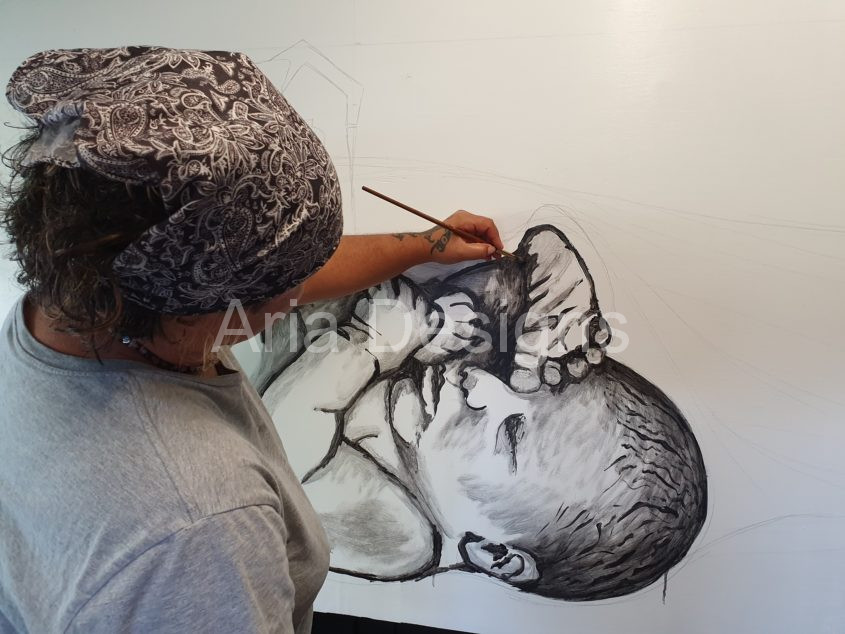
Through my painting practice I explore what Mana Wahine means to me with curiosity and authenticity. Generations later, relying on the language of symbology to invoke the resilient and courageous women of my own whakapapa with new meaning, form and force.
Land, culture and language – all threatened, emerging as feminine energy – profuse, active and absolute. In the creative space her manifestations are diverse.
These are the qualities I strive to express in my painting.
Mana Wahine – Creation and Destruction
He Whare Tangata (the house of man kind) – is a symbol for creation and destruction from which both life (conception) and death must pass (menstruation).
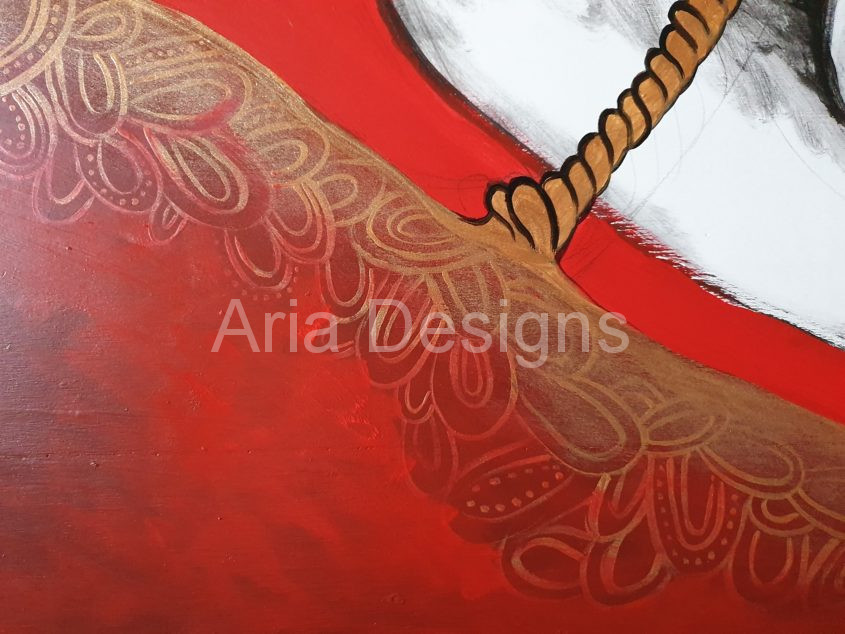
This cycle provides metaphor for my painting process.
The constant ebb and flow of an idea, its construction and deconstruction.
This is the nature of the creative process.
Whenua ki te Whenua
Whenua means both placenta and land responsible for the nourishment of our physical body. The two are linked through the burial of the placenta after birth and then eventually the body in death.
Hapu means to be pregnant and it also means a kinship group.
Papatuanuku is the earth and is intrinsically tied to the social, cultural, spiritual and economic well being of Tangata Whenua.
The use of traditional kowhaiwhai in my painting represents connection to whakapapa (geneology) whenua (land) tupuna (ancestors) and atua (gods).
From earth to sky this bloodline is direct and unwavering, a spiritual umbilical cord that tethers me to past, present and future.
Mana Wahine, is a re-assertion of who I was, who I am, and who I am yet to become.